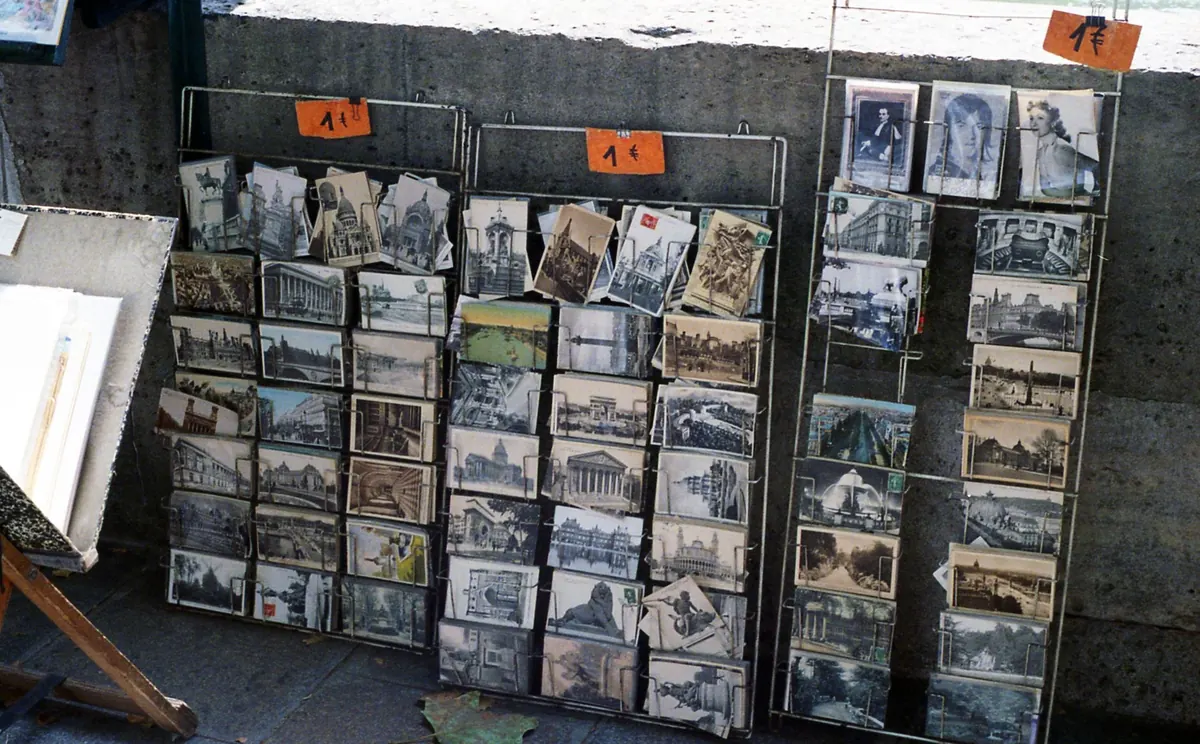
A postcard from Italy is easy to buy and hard to buy well. The rack by the museum exit, the spinning stand outside a tabacchi, the tray on the hotel reception desk — they all offer something, and most of it is forgettable. Then there is the other card: the one printed a few streets away from the view it shows, on paper with a bit of tooth, by a publisher whose name appears in small type on the back. That card is worth the extra two minutes of looking.
Italy changes its visual language every few hundred kilometres, and its postcards change with it. The sepia vedute of Rome, the watercolour hills of Tuscany, the etched canals of Venice, the painted cart panels of Sicily — each region has a tradition worth knowing before you start flipping through the rack. This guide runs through those traditions, then ends with the practical business of stamps, addresses and postmarks.
What to Look For in an Italian Postcard
Quality is rarely advertised. You have to read it off the card itself. A few things are worth checking before you commit.
- Paper with a little weight and texture. Thin, high-gloss card curls in a bag and feels disposable in the hand. Cards with a matte or lightly textured finish survive the post better and look better pinned to a wall.
- Clean printing. Look at the sky. If it is banded, muddy, or pixelated at arm's length, the source file was small and the print run was cheap.
- A name on the back. Publishers of good Italian cards usually identify themselves — often with the word edizioni and a town — and sometimes print a series number. A named local publisher is the single most useful signal you will get.
- Subject matter that could only come from here. A view of the street you just walked down beats a generic composition of a gondola at sunset.
- Illustration where it suits. Screen prints, watercolours and reproductions of old engravings age better than most photographs, and they say more about the place than a saturated panorama.
Skip the ten-view multiview unless you genuinely like the format. And be careful with "vintage" cards: some are genuine old stock, many are modern reprints of a nineteenth-century image printed on card that has never aged a day. Neither is wrong, but they are different things, and shopkeepers will usually tell you which is which if you ask.
Rome and Lazio: The Classic Veduta
Rome has been printing its own image since before printing was easy. The dominant postcard here is the veduta — the formal city view — and the best ones owe something to the engravers of the eighteenth century: the umbrella pines above the Colosseum, the dome of St Peter's floating over the rooftops, the Tiber curving away toward the Vatican.
Look for views in black and white or warm sepia, and for reproductions of Piranesi's etchings, which are sold everywhere but are printed properly in museum shops. The Pincio terrace, the Aventine keyhole, and the bell towers of Trastevere all reward the search. Outside the city, Lazio offers Hadrian's Villa at Tivoli, the dying town of Civita di Bagnoregio, and the coast at Sperlonga — quieter subjects on quieter cards.
Florence and Tuscany: Renaissance Light in Print
Florence sells the Renaissance hard, and the best cards lean into it: the Duomo seen from Piazzale Michelangelo at first light, the Arno from the bridges, the cloisters and courtyards that tourists photograph with their phones held high. The Grand Tour engraving tradition is still visible in the stock of the better shops, and reproductions of those old views make fine souvenirs.
Beyond Florence, the region has a whole genre of its own — rolling hills, cypress avenues, the Val d'Orcia at harvest — plus Siena's Palio and the walls of Lucca. To find cards with some character, head for the cartolerie, the paper shops, rather than the souvenir kiosks. Several near Santa Croce and around the Duomo sell marbled paper, letterpress printing and locally drawn views alongside their notebooks. Museum shops at the Uffizi and Palazzo Vecchio are reliable, if predictable, and their printing is usually excellent.
Venice and the Lagoon: Beyond the Grand Canal
Venice is the most photographed city in Italy and therefore the most badly served by its own postcard racks. You will see the same three gondola shots a hundred times before lunch. The alternative is easy: look for the minor canals, the lagoon islands, the view from a vaporetto, the cathedral at Torcello, the painted houses of Burano.
The city has a strong etching and aquatint tradition, and small print studios in Cannaregio and Castello sell cards that reflect it — line work, pale water, quiet compositions. Museum shops are good here too, particularly those attached to the smaller palazzi, which tend to stock cards tied to their own collections. Buy three or four at once. Venice is a city where you will want to write to more than one person.
Southern Italy: Naples, the Amalfi Coast and Puglia
Naples has the best postcard tradition in the south, and it comes in two forms. The first is the classic bay: Vesuvius behind the water, the Castel dell'Ovo, the long curve of the seafront. The second is the gouache landscape tradition of the nineteenth-century Neapolitan school, still alive in small workshops that sell bright, slightly loose painted views of the bay and the old quarters.
The Amalfi Coast is the opposite case: over-saturated cards of Positano that flatten one of the most beautiful stretches of coastline in Europe. Look instead for older lithographs of the coast road or cards by local photographers who have resisted the contrast slider. Puglia rewards attention — the trulli at Alberobello, the white lanes of Ostuni, olive groves, the baroque of Lecce — and so does Matera in neighbouring Basilicata, whose stone sassi make unusually atmospheric cards.
Sicily, Sardinia and the Island Style
Sicily has the richest visual vocabulary of any Italian region, and its cards borrow from it freely: Mount Etna smoking above the sea, the markets of Palermo, the baroque facades of Noto and Ragusa. Look especially for panels of traditional cart painting — the carretto siciliano — with their bright yellows and reds, geometric borders and scenes of knights and saints. Imagery from the Opera dei Pupi, the island's puppet theatre, turns up on good cards too.
Sardinia goes its own way. The murals of Orgosolo, the nuraghi, the coloured houses of Bosa and the weaving patterns of the interior all make the jump to card form, often printed by small local presses rather than national publishers. On both islands, the smaller the shop and the more specific the view, the better the card.
Northern Italy: Lakes, Alps and Design Cities
The north splits neatly in three. Around Lake Como, Garda and Maggiore, the best cards reproduce the lithographed hotel views and early travel posters of the late nineteenth and early twentieth centuries — a Liberty-era aesthetic that suits the lake towns perfectly. In Milan and Turin, look for mid-century graphic design: bold lettering, flat colour, the Galleria and the Duomo in Milan, the arcades and the Mole Antonelliana in Turin. Design bookshops and museum shops are the places to look.
The Dolomites run on a different logic. Mountain cards tend to be printed by local tourist boards and alpine associations, and they are often straightforward photographs of a peak at the right hour. Trentino-Alto Adige has the added pleasure of bilingual German-Italian cards, which make a nice detail for anyone collecting. Buy mountain cards in the town nearest the mountain, not in the airport.
Practical Notes for Buying and Sending
Buy from museum shops, stationers and independent bookshops first, kiosks second. Ask the person behind the counter which cards are printed locally — it is a normal question and usually starts a good conversation. Keep one card from each place for yourself; the ones you send will be gone.
For posting, the sequence is simple:
- Write the address in block capitals, leaving the top right corner clear for the stamp.
- Buy stamps at a post office or a tabacchi. International rates change, so ask for the current one rather than relying on memory.
- Ask at the counter whether they will hand-cancel the card. Not every office will, but a clean postmark from the town you visited is half the souvenir.
- Post it early in the trip. Cards mailed on the last morning often arrive weeks late, or not at all.
Use
Photo: Jill Evans / Pexels